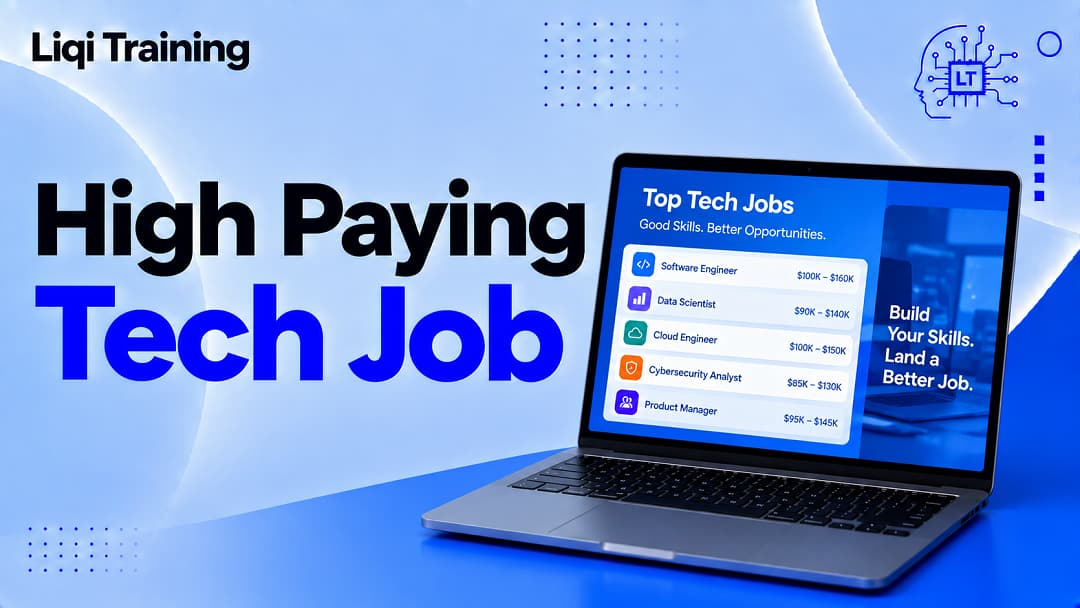
A high paying tech job is achievable without a four-year degree if you can prove your skills through real, verifiable work. Employers increasingly hire based on demonstrated ability, portfolios, certifications, and test projects, rather than academic credentials alone. The fastest path combines one focused skill, one public portfolio, and a targeted application strategy rather than a scattershot approach. Salary negotiation and continuous upskilling matter just as much as landing the first offer. Every step below links to a deeper guide so you can act on it immediately instead of guessing at the details.
A year ago, my friend was working a retail shift for $14 an hour with no college degree and no formal tech background. Today, she works remotely as a mid-level web developer earning well over six figures. Her path was not luck. It followed a specific, repeatable sequence that skipped the traditional four-year-degree route entirely and went straight for provable skill and strategic positioning.
This guide breaks down exactly what she did, in order, so you can apply the same framework to your own job search. Every stage below builds directly on the one before it, and each has its own dedicated resource if you want to go deeper on any single step.
Why a Degree Is No Longer the Only Path In
Tech hiring has shifted meaningfully over the past several years. Many companies, including large employers like Google, IBM, and Apple, have publicly removed degree requirements from a growing share of their technical job postings. This shift happened because hiring managers found that a diploma does not reliably predict whether someone can write clean code, debug a production issue, or ship a working feature on time. A portfolio and a technical interview do that far more reliably.
This does not mean the door is wide open with no effort required. It means the barrier moved from “credential” to “proof.” My friend’s entire strategy was built around generating proof as quickly and visibly as possible.
Step One: Pick One Skill and Go Deep, Not Wide
The first mistake most self-taught job seekers make is trying to learn five things at once, a little Python, a little design, a little marketing, and ending up mediocre at all of them. My friend picked a single lane: front-end web development, with React as her core tool. She stayed with it for four straight months before branching out.
If you’re deciding what to focus on, it helps to look at what is currently paying well and hiring consistently, rather than guessing. A resource like Best Programming Languages for Remote Tech Jobs: What I’d Learn for Real Job Options is a useful starting point, since it breaks down which languages actually convert into remote job offers rather than just sounding impressive on a resume.
Depth matters more than breadth at this stage because interviewers test for depth. A candidate who can explain how something works under the hood beats a candidate who has only surface familiarity with ten different tools.
Step Two: Build a Portfolio That Proves the Skill
Certificates alone rarely convince hiring managers, because a certificate only proves you finished a course. A portfolio proves you can build something that works. My friend built three projects: a small e-commerce front end, a weather app that pulled from a live API, and a clone of a well-known productivity tool. Each project lived on GitHub with a clear README explaining what it did and why she made the technical choices she did.
The projects did not need to be original ideas. Recruiters are not judging creativity at this stage; they are judging whether the code runs, whether it’s organized, and whether you can talk through your decisions in an interview. That last part is critical; she rehearsed explaining every project out loud before she ever got a callback.
Step Three: Layer On Skills That Are Actually Future-Proof
Once the first skill was solid, she added complementary skills that employers were consistently asking for, particularly around cloud infrastructure. Cloud knowledge has become one of the most requested skill sets across nearly every tech role, not just infrastructure jobs, because most companies now run their products on cloud servers rather than physical ones.
A good reference here is Top Cloud Computing Skills Employers Want Most, which outlines which cloud tools show up most often in job postings. She also leaned on 5 Evergreen Tech Skills That Still Matter in the AI Era to avoid wasting time on tools likely to be automated away within a few years. The goal at this stage was not to become an expert in everything, but to make sure her core skill was supported by adjacent skills that made her more resilient to industry shifts.
This is also where soft skills started to matter. Communication, collaboration, and the ability to explain technical decisions to non-technical people came up in nearly every interview she had. 5 Best Soft Skills Employers Value Most covers the specific ones that come up most often in technical interviews, which is worth reviewing before you start applying.
Step Four: Search Strategically Instead of Applying Everywhere
With a portfolio and a skill set in place, the next phase was the job search itself. Rather than mass-applying to every listing on general job boards, she focused on platforms and channels known to actually convert into interviews for self-taught candidates. How to Find and Apply for Tech Job Opportunities: Step-by-Step Practical Guide outlines exactly how to structure this search so your time goes toward listings with a realistic shot, not just a high volume of applications.
Remote roles were the priority, both because they widened her pool of potential employers and because many remote-first companies were already comfortable hiring without a degree. 5 Remote Tech Job Ideas That Pay Over $100,000 a Year was a direct reference point for which roles to target.
She also thought ahead about job security. Rather than picking a role at risk of automation, she cross-checked her target roles against 7 Tech Jobs That Will Survive AI Replacement, which helped her avoid roles likely to shrink over the next several years.
Step Five: Handle the Interview and the Offer With Confidence
Getting the interview is only half the battle. My friend’s technical interviews focused heavily on walking through her portfolio projects, explaining trade-offs, and solving small live coding problems. None of the interviews asked about her educational background once her portfolio was in front of them.
When the offer came in, she did not accept the first number on the table. Instead, she used a structured approach to counter it, referencing market rate data for her specific role and location. How to Negotiate a Higher Tech Salary Without Sounding Pushy was the exact resource she used to prepare her counteroffer script, and it resulted in a starting salary roughly 15 percent above the initial offer.
What to Do While You’re Still Building Toward Your First Role
Not everyone can commit to full-time skill-building for four months without income. If you need to earn while you learn, side income options exist that keep you close to the tech industry rather than pulling you away from it. 10 Tech Side Hustles to Earn Extra Income From Home lists options that build relevant experience while you study. Some people also explore social platforms for extra income during this period; How I Made Money Using TikTok App Explained: Full Guide is one option worth understanding, though it works best as a side stream rather than a replacement for the core plan.
It’s also worth learning from other people’s missteps before you make your own. Trying to Earn Online: Mistakes I Made (So You Don’t) covers common traps like chasing too many income streams at once or investing money into unproven programs, both of which can slow down an otherwise solid job search plan.
Where This Path Can Lead Long-Term
Once you’re in your first tech role, growth options open up quickly. Some professionals move toward specialized, higher-paying tracks such as machine learning or AI product management. Best Machine Learning Jobs for Beginners: Roles Worth Understanding Before You Specialize and AI Product Manager Jobs Explained: What the Role Really Looks Like are both useful for mapping out what comes after the first job, since a high paying tech job with no degree is often a starting point rather than a ceiling.
Conclusion
The absence of a degree is not the barrier it once was in tech hiring, but it does shift the responsibility onto you to prove your ability through visible, verifiable work. My friend’s path worked because each step built directly on the last: one focused skill, a portfolio that demonstrated it, supporting skills that made her resilient, a targeted job search, and a confident negotiation once the offer arrived. None of these steps requires a classroom. All of them require consistency and a plan you actually follow through on.
If you’re starting from zero today, the sequence above is the same one to follow. Pick your skill, build in public, apply strategically, and negotiate before you sign.
ADVERTISEMENT