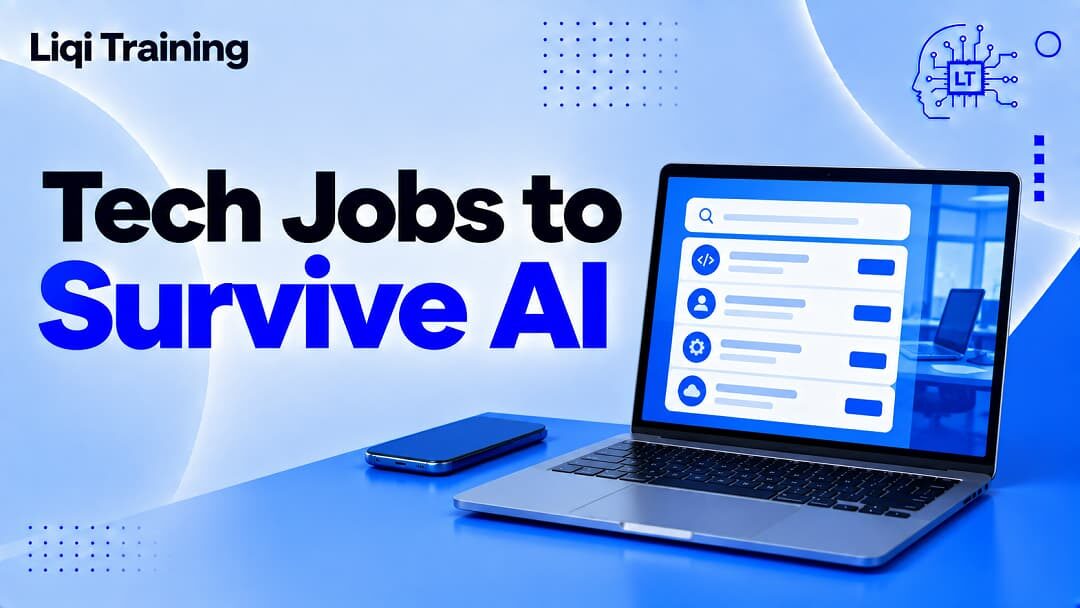
No job is entirely immune to AI-driven change, but certain tech jobs rely on skills that current automation genuinely struggles to replicate. Roles requiring judgment, ambiguity handling, and cross-functional communication tend to be more resilient than narrow, repeatable technical tasks. This list reflects informed analysis based on how AI tools currently perform, not a guarantee about how the job market will look in the future. Several of these roles are ones you can start building toward now, using the same skill-building approach used for other tech jobs. Resilience does not mean these roles stay unchanged; it means the core value they provide is harder to fully automate away.
A quick note before this list: predicting exactly which tech jobs will exist in ten years is inherently uncertain, and anyone claiming total certainty about it is overstating what can actually be known. What follows is an informed interpretation based on where AI tools currently excel, where they consistently fall short, and what that pattern suggests about which tech jobs are more resilient than others. It is not a guarantee, and it should be treated as reasoned analysis rather than settled fact.
With that framing in place, here are seven tech jobs that are well positioned to remain in demand, along with the specific reason each one is harder to automate away than it might first appear.
1. Machine Learning Engineer
It might seem counterintuitive that a job focused on building AI systems is itself resistant to AI replacement, but the reasoning holds up. Someone still has to design, train, evaluate, and maintain the models that power AI tools in the first place, and that work requires judgment about data quality, model behavior, and edge cases that current automation cannot reliably self-manage. If you’re curious about how to enter this field without jumping straight into advanced specialization, Best Machine Learning Jobs for Beginners: Roles Worth Understanding Before You Specialize breaks down the entry points that don’t require an advanced degree to start.
2. Cloud Infrastructure and DevOps Engineer
Cloud infrastructure work involves managing systems where mistakes carry real financial and security consequences, which makes full automation a much higher-risk proposition than it is in less critical areas. AI tools can assist with routine configuration tasks, but the decision-making around scaling, security, and system architecture still benefits heavily from human oversight. Top Cloud Computing Skills Employers Want Most covers the specific skills within this field that remain in high demand, which is a useful reference if you’re considering this path.
3. Cybersecurity Analyst
Cybersecurity is an adversarial field, meaning the people building attacks are constantly adapting to new defenses, including AI-based ones. This dynamic actually increases the need for human analysts rather than reducing it, since automated defenses need to be interpreted, tuned, and second-guessed by people who understand both the technology and the intent behind an attack. This role also tends to appear consistently on lists of evergreen tech skills for exactly this reason; 5 Evergreen Tech Skills That Still Matter in the AI Era covers several skills in this category worth building toward.
4. Product Manager
Product management sits at the intersection of technical understanding, business strategy, and human communication, which makes it a poor candidate for full automation. The core of the job involves interpreting ambiguous, sometimes conflicting priorities from users, executives, and engineers, then translating that into a coherent plan, a task that depends heavily on judgment and context rather than pattern-matching alone. AI Product Manager Jobs Explained: What the Role Really Looks Like covers a specific, growing variation of this role focused on AI products themselves, which is worth understanding given how central AI has become to product strategy across the industry.
Read also: How to Negotiate a Higher Tech Salary Without Sounding Pushy
5. UX Researcher
Understanding why users behave a certain way, not just what they clicked, requires observing nuance, asking follow-up questions, and interpreting behavior in context, none of which current AI tools do reliably on their own. UX research also depends on building trust with research participants, something that remains a distinctly human skill. This role is a strong example of how soft skills and technical understanding combine to create resilience; 5 Best Soft Skills Employers Value Most covers several of the communication-based skills that make this kind of role harder to automate.
6. Solutions Architect
Solutions architects design how different systems fit together to solve a specific business problem, which requires understanding not just the technology but the organization’s constraints, budget, and existing infrastructure. This kind of holistic, context-dependent design work resists automation precisely because every situation involves a different combination of constraints that don’t reduce cleanly to a repeatable pattern. Strong technical foundations still matter here, and Best Programming Languages for Remote Tech Jobs: What I’d Learn for Real Job Options is a reasonable starting point for building the technical base this role depends on.
7. Technical Sales and Solutions Engineering
Technical sales roles combine deep product knowledge with relationship-building and negotiation, a combination that depends on reading a client’s specific concerns and adjusting the pitch accordingly. This kind of real-time, relationship-driven adjustment remains difficult for AI tools to replicate convincingly, especially in high-stakes enterprise sales where trust plays a large role in the final decision. If you’re building toward any of the roles on this list, understanding how to advocate for your own value matters just as much as advocating for a product’s; How to Negotiate a Higher Tech Salary Without Sounding Pushy applies the same underlying negotiation skill to your own career rather than a sales pitch.
What These Seven Roles Have in Common
Looking at this list together, a clear pattern emerges. Every role here depends on some combination of ambiguity handling, high-stakes judgment, or relationship-based trust, three things current AI tools struggle to replicate convincingly at scale. Roles built around narrow, repeatable, clearly-defined tasks are the ones most exposed to automation, while roles built around interpreting context and navigating uncertainty tend to hold up better.
This pattern is useful even beyond the seven roles listed here. If you’re evaluating a tech job that isn’t on this list, asking whether the role depends mainly on repeatable tasks or on judgment and context is a reasonable way to estimate its resilience, even though it remains an estimate rather than a certainty.
Read also: Remote AI Jobs for Beginners: Skills, Roles, and How to Start From Nigeria
Building Toward One of These Roles
If you’re starting from scratch, the entry path into any of these roles looks similar to entry paths into tech more broadly: build a demonstrable skill, create a portfolio or track record that proves it, and apply strategically rather than broadly. How My Friend Got a High Paying Tech Job With No Degree: Complete Step-by-Step Guide walks through this exact process in detail, and the same underlying approach applies whether your target role is on this list or elsewhere in tech.
It’s also worth building experience gradually rather than waiting for a single, perfect opportunity. 10 Tech Side Hustles to Earn Extra Income From Home covers several ways to start building relevant, portfolio-worthy experience in roles like these before committing to a full-time job search.
Conclusion
None of the seven tech jobs covered here are guaranteed to remain completely unchanged as AI tools continue to improve. What they share is a reliance on judgment, context, and human trust that current automation has not reliably replicated, which makes them reasonable bets for long-term resilience rather than certainties. If you’re planning a tech career with longevity in mind, prioritizing roles built around ambiguity and human judgment, rather than narrow repeatable tasks, is a sound strategy based on what’s currently observable, even though no one can predict this with complete certainty.
ADVERTISEMENT