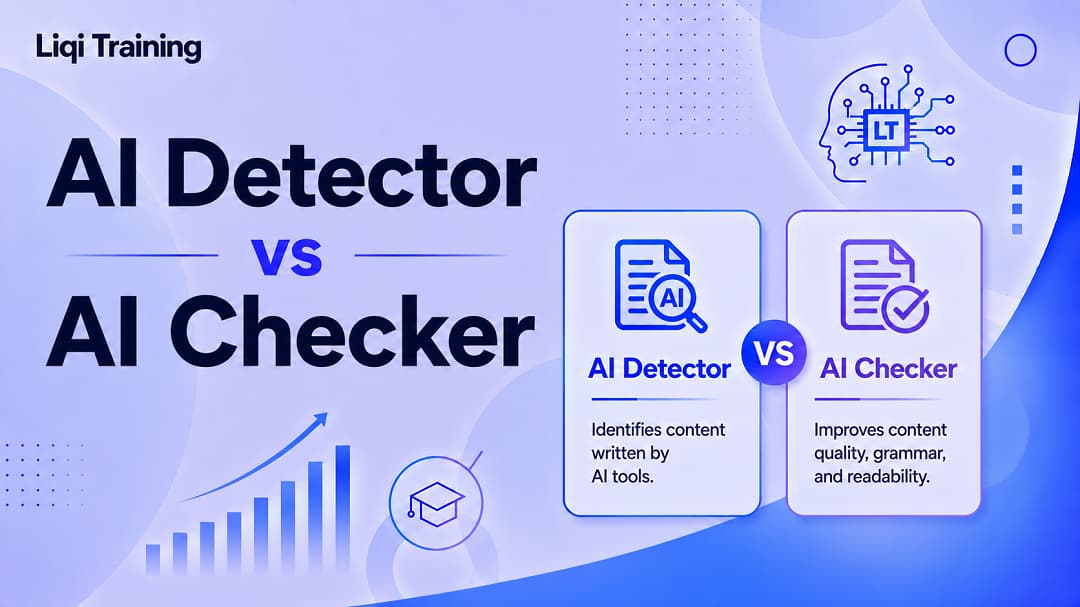
AI detector and AI checker are generally interchangeable terms. Both estimate the probability that text was generated or heavily assisted by AI. No AI detection tool can guarantee 100% accuracy. Detection results should be treated as supporting evidence, not definitive proof of authorship. False positives and false negatives remain significant challenges, especially with edited or hybrid content. Using multiple evaluation methods is more reliable than relying on a single AI detection score.
Artificial intelligence has transformed how people write emails, articles, reports, essays, and marketing copy. As AI writing assistants have become more sophisticated, a new category of software has emerged to answer an equally important question:
Was this content written by a human or generated by AI?
This challenge has led to the rapid growth of AI detectors and AI checkers. Schools use them to support academic integrity, publishers use them to review submissions, businesses use them for quality assurance, and content creators rely on them before publishing online.
However, one question continues to dominate search engines:
Is there actually a difference between an AI detector and an AI checker?
The short answer is not usually. In most cases, the two terms describe the same type of software. The differences are typically found in branding, user interface, reporting features, and detection methodology rather than in the underlying purpose.
This guide explains how both tools work, compares their strengths and weaknesses, examines current accuracy levels, and helps you decide which solution best fits your needs.
AI Detector vs AI Checker at a Glance
Before exploring the technical details, it’s helpful to compare these tools side by side.
| Feature | AI Detector | AI Checker |
|---|---|---|
| Primary purpose | Identify likely AI-generated text | Identify likely AI-generated text |
| Technology | Statistical analysis and machine learning | Statistical analysis and machine learning |
| Probability score | Yes | Yes |
| Highlights suspicious passages | Often | Often |
| Detects plagiarism | Usually no | Usually no |
| Guarantees accuracy | No | No |
| Best used for | Reviewing content | Reviewing content |
For most users, the practical difference is minimal. A company may market its product as an “AI Checker” while another uses “AI Detector,” even though both analyze writing for AI-generated patterns.
What Is an AI Detector?
An AI detector is software designed to estimate whether a piece of text was produced by an artificial intelligence model rather than written entirely by a human.
Unlike plagiarism checkers, AI detectors do not compare text against existing websites or databases.
Instead, they analyze characteristics such as:
- Word predictability
- Sentence structure
- Writing rhythm
- Vocabulary usage
- Statistical language patterns
- Model-specific stylistic signals
The output is typically a probability score, indicating how likely the text is to have been generated by AI. It is not a statement of certainty.
Common Uses of AI Detectors
Organizations use AI detectors in different ways depending on their objectives.
Education
Schools and universities may use AI detection tools to help identify assignments that warrant further review.
Importantly, many institutions recommend combining detector results with instructor judgment rather than treating the score as conclusive evidence because false positives can occur.
Publishing
Editors may scan guest articles to understand whether AI played a significant role in drafting the content.
The purpose is often to verify editorial policies rather than prohibit AI entirely.
SEO Content
Website owners sometimes use AI detectors to evaluate:
- Content originality
- Writing consistency
- Editorial quality
- Compliance with internal publishing standards
It is worth noting that search engines generally focus on the quality and usefulness of content rather than whether AI assisted in creating it.
Business
Companies increasingly review reports, proposals, and customer-facing documents to ensure they meet quality and compliance standards before publication.
Read also: Best AI Data Analysis Tools for Beginners: What I’d Use First and Why
What Is an AI Checker?
An AI checker performs essentially the same function.
It analyzes writing and estimates whether AI contributed to its creation.
The difference usually lies in branding.
Some software providers prefer the word checker because it sounds more approachable to general users, while others choose detector to emphasize analytical capabilities. In practice, both names typically describe probability-based classification tools.
Typical AI Checker Features
Modern AI checkers commonly include:
- AI probability scores
- Sentence-by-sentence analysis
- Highlighted passages
- Confidence indicators
- Downloadable reports
- Multi-language support
- API integrations
- Batch document scanning
Some platforms also combine AI detection with plagiarism detection, grammar correction, or writing assistance, though these are separate capabilities.
Are AI Detector and AI Checker Really Different?
For most users, no.
The terms are largely interchangeable.
If you compare major platforms, you’ll notice that many products labeled as “AI Checkers” describe the exact same detection process used by products marketed as “AI Detectors.”
The naming difference is primarily a marketing decision rather than a technical distinction.
Why the Two Names Exist
Software companies choose different terminology to appeal to different audiences.
For example:
- AI Detector often suggests forensic analysis or institutional use.
- AI Checker often appeals to students, bloggers, freelancers, and general consumers seeking a quick review.
Regardless of the label, the underlying objective remains the same: estimate whether writing exhibits patterns commonly associated with AI-generated text.
Why AI Detection Has Become More Challenging
When the first public AI writing tools appeared, their output often followed repetitive sentence structures and predictable wording.
Modern language models produce more varied, natural-sounding text, making reliable detection increasingly difficult.
At the same time, users frequently edit AI-generated drafts before publishing them. Even simple revisions, such as changing sentence order or rewriting paragraphs, can reduce a detector’s confidence. Recent research and real-world testing show that detector performance varies significantly depending on the model used, the length of the text, and the extent of human editing.
Why Accuracy Matters
Detection results can influence important decisions.
For example:
- A student may face questions about academic integrity.
- An editor may reject or request revisions to a submission.
- A business may review compliance documentation more closely.
- A publisher may apply additional editorial checks.
Because of these consequences, experts consistently recommend treating AI detection scores as indicators rather than definitive proof. No current detector can reliably identify every AI-generated document or guarantee that every human-written document will be classified correctly.
How AI Detection Actually Works
One of the biggest misconceptions about AI detection software is that it can determine with certainty whether a person or an AI wrote a document.
In reality, modern AI detectors do not understand meaning, intent, or authorship the way humans do. Instead, they analyze statistical writing patterns and compare them with characteristics commonly found in both human-written and AI-generated text. The final result is an estimate, a probability score, not a definitive judgment.
To reach that estimate, most commercial AI detectors combine several analytical techniques rather than relying on a single metric.
Step 1 – Text Preprocessing
Before analysis begins, the detector prepares the document.
Typical preprocessing tasks include:
- Removing unnecessary formatting
- Separating sentences
- Breaking text into tokens (words or word fragments)
- Measuring sentence length
- Identifying punctuation patterns
- Detecting repeated phrases
This standardized representation makes it easier for the detection model to evaluate writing characteristics consistently.
Step 2 – Statistical Pattern Analysis
After preprocessing, the detector examines whether the writing resembles known AI-generated language patterns.
Rather than asking, “Who wrote this?” the system asks questions such as:
- How predictable are the word choices?
- Does the sentence rhythm vary naturally?
- Is vocabulary unusually repetitive?
- Does the writing resemble previously analyzed AI outputs?
These statistical signals become inputs for the final probability score.
The Core Signals AI Detectors Measure
Although companies rarely disclose every detail of their proprietary algorithms, many detectors evaluate similar linguistic characteristics.
Perplexity
Perplexity measures how predictable a piece of writing appears to a language model.
What Does Low Perplexity Mean?
Low perplexity suggests that the next word in a sentence is relatively easy for a language model to predict.
For example:
“The sun rises in the east every morning.”
Every word follows a highly expected pattern.
AI-generated writing often produces lower perplexity because language models are optimized to predict statistically likely word sequences.
What Does High Perplexity Mean?
Higher perplexity indicates that writing contains more unexpected vocabulary, varied phrasing, or creative expression.
Human writers naturally introduce:
- Personal anecdotes
- Idioms
- Humor
- Regional language
- Stylistic variation
These characteristics can increase unpredictability.
However, high or low perplexity alone does not prove authorship. Formal, technical, translated, or non-native English writing can also have low perplexity while still being entirely human-written.
Burstiness
Burstiness measures variation in sentence rhythm and structure.
Human writing typically alternates between:
- Short sentences.
- Longer explanatory paragraphs.
- Questions.
- Fragments.
- Emphasis.
This natural variation creates higher burstiness.
Why AI Often Shows Lower Burstiness
Many AI-generated drafts maintain a more consistent rhythm.
For example:
- Similar sentence lengths
- Repeated paragraph structure
- Predictable transitions
- Uniform complexity
Although newer language models produce more varied output than earlier generations, burstiness remains one signal used in many detection systems. It is considered supportive evidence rather than proof.
Stylometry
Stylometry is the study of writing style.
Instead of focusing on content, stylometric analysis examines characteristics such as:
- Vocabulary diversity
- Function-word usage
- Punctuation habits
- Average sentence length
- Grammatical preferences
- Syntax patterns
Researchers have long used stylometry for authorship attribution, and modern AI detectors increasingly incorporate these features alongside machine-learning classifiers.
Why Stylometry Matters
Every writer develops habits.
For example, one author may:
- Prefer long paragraphs.
- Use semicolons frequently.
- Begin sentences with conjunctions.
- Favor concise language.
Stylometric systems compare these patterns against known writing characteristics to estimate whether a document resembles typical AI output.
Machine Learning Classifiers
Modern AI detectors do not rely solely on perplexity or burstiness.
Instead, many use supervised machine-learning models trained on large collections of:
- Human-written documents
- AI-generated documents
- Edited AI drafts
- Academic writing
- News articles
- Technical documentation
During training, these models learn combinations of features that help distinguish statistical differences between writing styles.
Ensemble Detection
Many commercial products combine multiple analytical methods.
For example, a detector may evaluate:
- Perplexity
- Burstiness
- Stylometric features
- Repetition
- Token probability
- Classifier confidence
The system then aggregates these signals into a single probability score.
This ensemble approach generally produces more reliable results than relying on one metric alone.
Why Different AI Detectors Give Different Scores
One of the most common user questions is:
“Why did one detector report 12% AI while another reported 81%?”
The answer is that AI detection tools are built differently.
Several factors contribute to inconsistent scores.
Different Training Data
Every company trains its models on different datasets.
Some emphasize:
- Academic essays
- Marketing copy
- News articles
- AI-generated samples
- Edited documents
Different datasets lead to different classification behavior.
Proprietary Algorithms
Most commercial AI detection companies do not publicly disclose their complete methodologies.
As a result, two detectors may assign different weights to the same linguistic features.
Model Updates
AI language models continue evolving rapidly.
Detection vendors regularly update their classifiers to recognize newer writing patterns.
Consequently, the same document may receive different scores over time as detection models improve.
Human Editing
Perhaps the biggest challenge involves hybrid content.
Many people now:
- Generate a first draft with AI.
- Rewrite sections manually.
- Add personal examples.
- Change sentence structure.
- Remove repetitive wording.
These revisions blur the statistical signals detectors rely on, making consistent classification much harder. Hybrid human-AI writing has become increasingly common and is one reason why many tools now return more cautious or uncertain results.
Why False Positives Happen
A false positive occurs when human-written content is incorrectly classified as AI-generated.
This remains one of the most significant limitations of current detection technology.
Situations that may increase false-positive risk include:
- Formal academic writing
- Technical documentation
- Legal documents
- Highly structured business reports
- Writing by non-native English speakers
- Grammar-corrected text
Research has shown that some detectors have disproportionately misclassified essays written by non-native English speakers because their writing may resemble the predictable statistical patterns that detectors associate with AI.
Why False Negatives Also Occur
A false negative is the opposite problem.
The detector concludes that AI-generated content is human-written.
This may happen when:
- AI output has been heavily edited.
- Multiple AI tools were used.
- The document contains substantial original human revisions.
- Newer language models produce more natural stylistic variation.
Because of these challenges, AI detection should be considered one component of a broader review process rather than a standalone decision-making tool.
To better understand the technologies discussed in this guide, you can also explore:
- What Is AI? A Complete Beginner’s Guide to Artificial Intelligence
- Gemini AI vs Claude AI: Which AI Assistant Is Better?
These related articles provide additional context on the AI systems that detection tools are designed to analyze.
The Most Popular AI Detectors and AI Checkers
The AI detection market has expanded rapidly over the past two years. Today, dozens of platforms promise to distinguish human-written text from AI-generated content. However, independent testing consistently shows that no single tool performs best in every situation. Accuracy depends on factors such as text length, writing style, the AI model used, and whether the content has been edited after generation.
Instead of searching for a universal winner, it’s more useful to compare tools based on their intended use.
GPTZero
GPTZero remains one of the most recognized AI detection platforms, particularly in education.
Best For
- Teachers
- Students
- Academic institutions
- Individual writers
Strengths
- Easy-to-understand reports
- Sentence-level analysis
- Free entry-level access
- Educational workflow
Limitations
- Accuracy decreases on heavily edited AI text.
- May produce false positives on highly formal writing.
- Scores should be interpreted alongside other evidence rather than as proof of AI use.
Originality.ai
Originality.ai is widely used by publishers, SEO agencies, and content marketing teams.
Unlike many educational tools, it focuses heavily on long-form web content.
Best For
- Bloggers
- SEO professionals
- Content agencies
- Publishers
Strengths
- Detailed AI reports
- Website publishing workflows
- Team collaboration
- Plagiarism checking
Limitations
- Subscription required for full functionality.
- Like all detectors, it is not immune to false positives or false negatives.
Turnitin AI Detection
Turnitin integrates AI detection into its long-established academic integrity platform.
Many schools and universities already use Turnitin for plagiarism detection, making AI detection a natural extension of existing workflows.
Best For
- Universities
- Colleges
- Schools
- Institutional assessment
Strengths
- LMS integration
- Familiar instructor interface
- Combined plagiarism and AI review
Limitations
Turnitin itself advises educators that AI detection scores should support, not replace, professional judgment. Some institutions have also reduced or limited reliance on automated AI detection because of concerns about false positives and fairness.
Copyleaks
Copyleaks combines plagiarism detection with AI content analysis.
Its multilingual support makes it attractive for organizations working across different languages.
Best For
- Businesses
- Enterprises
- Education
- Compliance teams
Strengths
- Multiple language support
- API integration
- Enterprise features
Limitations
Performance varies depending on document type and language, and it should be used alongside editorial review rather than as a standalone decision-maker.
Comparing AI Detectors Side by Side
| Tool | Best For | Main Strength | Main Limitation |
|---|---|---|---|
| GPTZero | Education | Easy reports | Less reliable on edited AI |
| Originality.ai | SEO & Publishing | Publisher-focused workflow | Paid service |
| Turnitin | Schools & Universities | LMS integration | Human review still required |
| Copyleaks | Business & Enterprise | Multilingual support | Results vary by content type |
The table highlights an important point: the best detector depends on your workflow, not simply on a published accuracy percentage.
Which Tool Is More Accurate?
Many users expect a simple ranking.
However, current evidence does not support declaring one detector universally superior.
Independent comparisons repeatedly conclude that:
- Different datasets produce different results.
- Different AI models are detected with varying success.
- Human editing significantly affects detection accuracy.
- Every detector has measurable false-positive and false-negative rates.
For these reasons, published accuracy figures from vendors should be interpreted carefully, as testing methodologies often differ.
Why Accuracy Percentages Can Be Misleading
A detector advertising “99% accuracy” does not necessarily outperform another claiming “95%.”
Important questions include:
- Which dataset was tested?
- How many documents were evaluated?
- Were the texts edited?
- Which AI models generated the samples?
- What false-positive rate was accepted?
Without standardized testing conditions, direct percentage comparisons can be misleading.
Understanding False Positives
False positives remain one of the biggest concerns surrounding AI detection.
A false positive occurs when genuinely human-written work is incorrectly classified as AI-generated.
This can have significant consequences in:
- Education
- Journalism
- Employment
- Publishing
Recent research and institutional guidance continue to emphasize caution, particularly for academic integrity decisions.
Who Is Most Affected?
Studies suggest higher false-positive rates may occur with:
- Non-native English writers
- Highly structured academic writing
- Technical documentation
- Concise professional reports
These patterns illustrate why AI detection scores should initiate review rather than determine outcomes automatically.
Choosing the Right Tool for Your Needs
Instead of asking, “Which AI detector is best?” ask, “Which detector fits my use case?”
For Students
Look for:
- Clear explanations
- Sentence-level feedback
- Easy-to-read reports
Remember that checking your own work before submission does not guarantee how another platform will classify it.
For Teachers
Prioritize tools that:
- Integrate with existing workflows
- Provide confidence scores
- Support manual review
Detection results should always be considered alongside writing history, drafts, and classroom knowledge.
For Bloggers and SEO Professionals
Publishing teams benefit from tools that combine:
- AI detection
- Plagiarism checking
- Team collaboration
- Document management
Quality, originality, and value to readers remain more important than pursuing a perfect detector score.
For Businesses
Organizations often need:
- API access
- Bulk document analysis
- Compliance reporting
- Security controls
Enterprise-grade platforms typically emphasize workflow integration rather than individual document scoring.
Best Practices for Using AI Detectors
To improve reliability:
- Use more than one detector when results matter.
- Review highlighted passages instead of relying only on the overall score.
- Consider the document’s context and purpose.
- Treat probability scores as indicators, not proof.
- Keep drafts and revision history when authorship may need to be demonstrated.
These practices align with the broader consensus that AI detection should support informed human judgment rather than replace it.
Can AI Detectors Really Be Trusted?
The short answer is yes, but only when their limitations are understood.
Modern AI detectors are valuable screening tools, but they cannot determine authorship with certainty. They estimate the likelihood that a document contains AI-generated or AI-assisted writing based on statistical patterns rather than direct evidence of who created the text. Organizations such as NIST emphasize that AI evaluations should include clear uncertainty estimates and appropriate interpretation rather than relying on a single accuracy figure.
For this reason, educators, publishers, and businesses increasingly treat detector results as one piece of evidence within a broader review process.
Why Human Review Still Matters
Even the most advanced detector cannot evaluate:
- A writer’s research process
- Personal interviews
- Original field observations
- Draft history
- Revision notes
- Creative intent
Human reviewers can assess these contextual factors, making their judgment an essential complement to automated analysis.
Best Practices for Improving Detection Accuracy
While no tool is perfect, following established practices can improve the reliability of AI detection.
Analyze Longer Documents
Short passages provide limited statistical information.
Whenever possible, evaluate documents that contain several hundred words or more, as longer samples generally allow detectors to identify linguistic patterns more consistently.
Use More Than One Detector
Different detectors are trained differently.
Running important documents through multiple reputable tools can help identify consistent trends rather than relying on a single probability score.
If several independent tools produce similar assessments, confidence may increase, although certainty is still not guaranteed.
Review Highlighted Sections
Many users focus only on the overall percentage.
Instead, examine:
- Flagged sentences
- Paragraph-level analysis
- Confidence indicators
- Explanatory notes
These details often provide more useful insight than the headline score.
Consider the Writing Context
Detection results should always be interpreted alongside contextual information.
Questions worth asking include:
- Was the author writing in a second language?
- Has the document been heavily edited?
- Does the writing follow a highly structured academic format?
- Was AI openly used for brainstorming or grammar assistance?
These factors may influence detection outcomes.
Common Myths About AI Detection
Misunderstandings about AI detectors are widespread. Separating fact from fiction helps users apply these tools responsibly.
Myth 1 – AI Detectors Are 100% Accurate
Reality
No publicly available AI detector can guarantee perfect accuracy.
Independent testing continues to show variation in performance across document types, AI models, and writing styles.
Myth 2 – A High AI Score Proves Someone Cheated
Reality
A high probability score indicates that the writing shares characteristics commonly associated with AI-generated text.
It does not prove misconduct or establish authorship.
Responsible organizations combine detector output with additional evidence before making important decisions.
Myth 3 – AI-Humanized Text Always Beats Detectors
Reality
Editing AI-generated content often makes detection more difficult, but there is no universal method that consistently bypasses every detector.
Likewise, detectors continue evolving to recognize new writing patterns.
The relationship between AI generation and AI detection remains an ongoing technological arms race.
Myth 4 – AI Detectors Replace Editors
Reality
Editors evaluate:
- Accuracy
- Logic
- Evidence
- Readability
- Brand voice
- Audience relevance
AI detectors evaluate only the statistical likelihood of AI involvement.
These are fundamentally different tasks.
The Future of AI Detection
As generative AI continues advancing, detection technologies are evolving beyond simple text analysis.
Emerging approaches include:
- Digital content provenance
- Cryptographic signatures
- Invisible watermarking
- Content Credentials (C2PA)
- Model-generated metadata
These methods aim to provide stronger evidence of content origin, although they also have limitations, particularly when content is edited or transformed. Recent reporting has shown that watermark-based systems can fail after common modifications such as cropping images, highlighting the need for multiple complementary approaches.
Rather than relying on one technique, experts increasingly recommend combining technical signals with editorial review and provenance information.
Frequently Asked Questions
Is an AI detector different from an AI checker?
In most cases, no.
The two terms are used interchangeably by software vendors. Both refer to tools that estimate whether text is likely to have been generated or significantly assisted by AI.
Can AI detectors identify every AI model?
No.
Detection performance varies depending on:
- The AI model used
- Document length
- Human editing
- Language
- Writing style
Newer AI models often require detector updates to maintain effectiveness.
Why do different detectors produce different scores?
Different companies:
- Train on different datasets.
- Use different algorithms.
- Prioritize different objectives.
- Update their models at different times.
As a result, identical documents may receive different probability scores.
Should businesses rely solely on AI detectors?
No.
For high-stakes decisions, AI detection should be combined with:
- Editorial review
- Version history
- Source verification
- Human expertise
Do search engines penalize AI-generated content?
Major search engines emphasize helpful, original, and trustworthy content rather than whether AI assisted in its creation. The quality, accuracy, and value provided to readers remain the primary considerations.
Conclusion
AI detectors and AI checkers have become valuable tools in an era where AI-assisted writing is increasingly common. Although their names differ, their purpose is largely the same: estimate whether text exhibits characteristics associated with AI-generated content.
However, the evidence available points to an important conclusion. No detector is universally accurate, and no probability score should be treated as conclusive proof. Differences in training data, detection methods, document type, and human editing all influence results.
For educators, publishers, businesses, and content creators, the most effective approach is to use AI detectors as part of a broader evaluation process, combining automated analysis with human judgment, contextual information, and transparent editorial standards.
As AI writing technology continues to evolve, detection systems will evolve alongside it. Understanding both their capabilities and their limitations will help you make more informed decisions about authenticity, quality, and responsible AI use.
ADVERTISEMENT