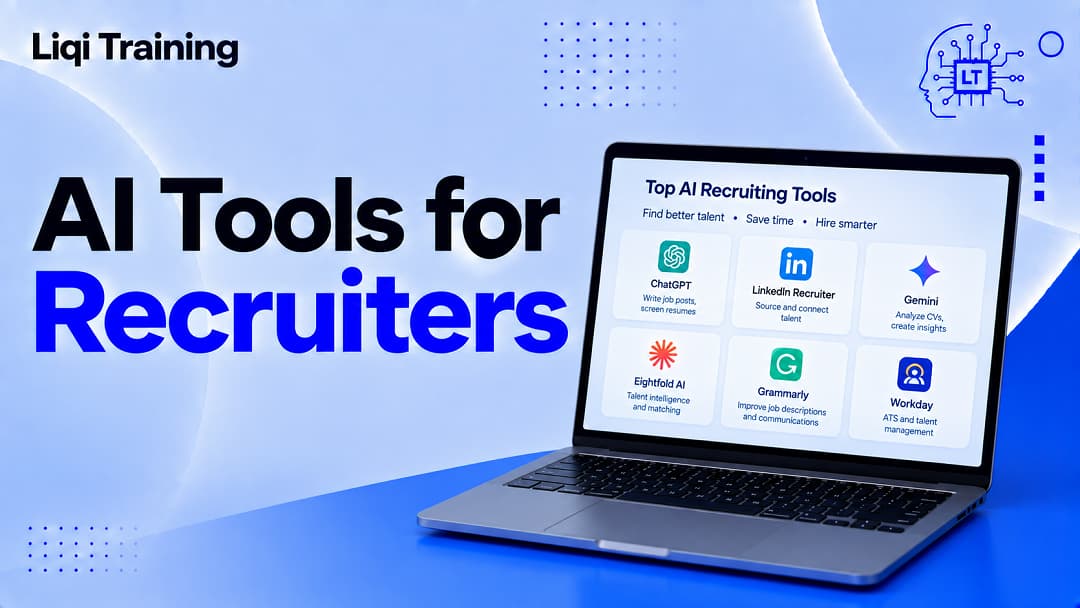
AI tool for recruiter supports productivity across sourcing, candidate communication, screening, scheduling, interview documentation, and workflow management. There is no single best AI recruiting tool for every organization. The right choice depends on the recruiting bottleneck, existing ATS, hiring volume, budget, and required integrations. LinkedIn’s AI-assisted recruiting features focus heavily on sourcing and candidate engagement, while platforms such as Greenhouse, Lever, Workday, Eightfold, HireVue, and others cover different parts of the recruiting workflow.
General-purpose AI assistants such as ChatGPT and Claude can help with writing, research, interview questions, summaries, and other recruiter tasks, but sensitive candidate information requires careful handling. Human oversight remains important, particularly when AI influences candidate evaluation or prioritization. Recruiters should measure AI by the time and quality it adds to the hiring process, not simply by the number of automated tasks.
Recruiting has always involved a lot of work that happens before a hiring manager meets a candidate. Recruiters search profiles, review resumes, write outreach messages, coordinate interviews, update applicant records, communicate with candidates, and keep hiring managers informed. AI is increasingly being added to those workflows. Current recruiting platforms use AI for tasks ranging from candidate discovery and profile matching to outreach, screening, scheduling, and summarizing information. LinkedIn, for example, now offers AI-assisted search and Hiring Assistant features designed to help recruiters find candidates, review profiles, and manage parts of the sourcing process.
But productivity does not simply mean automating as much recruiting work as possible. A faster process can still produce poor hiring decisions if recruiters cannot understand why candidates were surfaced, if information is inaccurate, or if automation creates a worse candidate experience. The most useful AI tools for recruiter productivity are therefore the ones that remove repetitive work while leaving important judgment and candidate decisions with people.
Where AI can make the biggest difference in recruiting
Recruiter productivity problems are often less about one difficult task and more about dozens of small tasks competing for attention.
A recruiter might spend part of the morning searching for candidates, switch to writing outreach, move into interview scheduling, answer candidate questions, review applications, and then return to sourcing later in the day.
That fragmentation is one reason AI can be useful.
Greenhouse’s 2026 research on recruiter experience found that nearly half of recruiters surveyed described their work experience as reactive and overloaded, while most reported spending at least half of their time on non-strategic work. The same research identified poor tool integration as a major technology frustration.
The opportunity is not necessarily to automate the entire process. It is to reduce the administrative load so recruiters can spend more time on conversations, assessment, relationship building, and hiring strategy.
AI tool for recruiter sourcing and candidate discovery
Finding potentially suitable candidates is one of the most obvious areas for AI assistance.
Traditional recruiting searches often depend heavily on keywords and filters. AI-assisted systems can allow recruiters to describe the type of person they are looking for using more natural language and then use that information to identify relevant profiles.
LinkedIn says its AI-Assisted Search can translate hiring requirements into search filters, suggest ways to expand candidate searches, and help recruiters discover talent pools they may otherwise miss. Its Hiring Assistant goes further by using a recruiter’s hiring goals to develop a sourcing strategy and produce a summarized shortlist.
This can be particularly useful when a recruiter knows what the hiring manager needs but does not yet have an efficient search strategy.
LinkedIn Recruiter and Hiring Assistant
LinkedIn’s recruiting platform is particularly relevant for organizations that already rely heavily on LinkedIn’s professional network.
Its AI capabilities can help with candidate discovery, profile review, prescreening questions, and personalized outreach. LinkedIn reports that customers using Hiring Assistant save an average of more than four hours per user per role, although this is a vendor-reported figure rather than an independently verified productivity benchmark.
That distinction matters when evaluating software. A vendor’s reported result can show what the product is designed to accomplish, but recruiters should test the workflow against their own hiring data before assuming the same outcome.
SeekOut, hireEZ, and other sourcing platforms
Dedicated sourcing platforms can provide another layer of AI-assisted discovery, particularly for recruiters who need to search beyond their existing applicant pool.
Current recruiting software comparisons commonly place sourcing platforms such as SeekOut and hireEZ alongside broader talent-intelligence and ATS products, but their strengths differ. Some are primarily designed for finding candidates, while others combine sourcing with outreach, analytics, or broader talent management capabilities.
The practical lesson is simple: choose the sourcing tool according to where your candidates are and how your recruiting team already works.
AI for writing job descriptions and recruiter outreach
Recruiters also spend considerable time writing.
Job descriptions, candidate emails, LinkedIn messages, interview invitations, follow-ups, rejection messages, and hiring-manager updates can all be drafted or improved with AI.
LinkedIn’s recruiting guidance specifically highlights AI-assisted job-description creation and personalized candidate messages as productivity applications. It reports that personalized InMails have a higher acceptance rate than non-personalized messages, although the exact result depends on the circumstances and LinkedIn’s own data.
General-purpose AI assistants can also be useful here.
For example, a recruiter could provide the requirements of a role and ask an AI assistant to create three versions of an outreach message:
- a concise initial message;
- a more detailed message for a highly relevant candidate;
- a follow-up for someone who has not responded.
The recruiter should then check every message before sending it.
AI can accelerate drafting, but it should not invent candidate experience, skills, company information, compensation details, or other facts.
AI for resume and application review
Candidate review is another area where AI is becoming increasingly embedded into recruiting platforms.
Some systems can parse resumes, identify skills, compare profiles with job requirements, prioritize applications, or help recruiters rediscover candidates already present in a talent database.
TechTarget’s 2026 overview of AI recruiting software describes the current market as spanning assistive AI, copilots, semi-agentic systems, and increasingly autonomous workflows. Candidate shortlisting and ranking are among the capabilities now offered by competitive recruiting platforms.
This can reduce the amount of manual searching recruiters need to perform.
However, candidate ranking should not automatically be treated as a hiring decision.
A candidate who does not match a conventional keyword pattern might still possess transferable skills, relevant experience under a different job title, or qualifications that the model does not interpret correctly.
That is why AI-generated rankings should be treated as decision support rather than unquestionable decisions.
AI for candidate screening and engagement
High-volume recruiting creates a different productivity challenge.
When hundreds or thousands of people apply for a role, recruiters may struggle to respond quickly to basic questions, conduct initial screening, and maintain consistent communication.
Conversational AI can help handle some of these interactions.
Recruiting platforms such as Paradox and Humanly, for example, are designed around candidate engagement and conversational workflows, while other recruiting suites combine screening with applicant tracking and talent management. Current recruiting software comparisons show that conversational screening, sourcing, ATS functionality, and interview tools are increasingly overlapping categories.
For recruiters, the advantage is not simply fewer emails.
A well-designed workflow can help candidates receive information sooner while allowing recruiters to concentrate on applicants who require human attention.
AI for interview scheduling and administrative work
Scheduling is one of the clearest examples of a task that can consume time without requiring much strategic judgment.
Recruiters may need to coordinate candidates, hiring managers, interview panels, calendars, time zones, rescheduling requests, and reminders.
AI-powered recruiting platforms increasingly incorporate scheduling and candidate communication into broader workflows. Some tools specialize in scheduling, while larger ATS and recruiting suites provide it as one component of the platform.
This is an area where automation can have a relatively straightforward productivity benefit because the task has defined inputs and outputs.
The recruiter still needs to establish the rules, but the system can handle much of the back-and-forth.
AI for interview notes and recruiter documentation
Recruiters also have to remember and document what happened during interviews.
AI-powered meeting and interview tools can transcribe conversations, summarize discussions, identify topics, and organize notes.
That can make it easier to prepare structured feedback for a hiring team.
The important safeguard is verification. An AI-generated summary can miss context, misinterpret a statement, or attribute something incorrectly.
Recruiters should therefore review interview summaries rather than treating automatically generated notes as a perfect record.
This is particularly important when interview documentation contributes to a candidate evaluation.
General-purpose AI tool for recruiter productivity
Recruiters do not necessarily need a specialized recruiting platform for every task.
General-purpose AI assistants can help with everyday work such as:
- rewriting a job description for clarity;
- generating Boolean search ideas;
- drafting interview questions;
- summarizing recruiter notes;
- creating candidate communication templates;
- organizing research;
- preparing hiring-manager updates.
The value here is flexibility.
A specialized recruiting platform may have direct access to structured candidate information and recruiting workflows, while a general-purpose AI assistant can be useful for broader writing and reasoning tasks.
The two categories can therefore complement each other rather than compete directly.
For example, a recruiter might use an ATS for applicant tracking, LinkedIn for sourcing, and a general AI assistant for drafting communication and creating interview questions.
How to choose AI tool for recruiter productivity
Choosing software based on a “best AI recruiting tools” list alone can lead to an expensive and poorly integrated technology stack.
Instead, start with the bottleneck.
If sourcing consumes most of your time
Look for AI-assisted search, candidate matching, talent discovery, and sourcing automation.
LinkedIn Recruiter with Hiring Assistant, SeekOut, and hireEZ are examples of tools positioned around different aspects of AI-assisted sourcing and recruiting.
If communication is the problem
Prioritize tools that can personalize outreach, manage follow-ups, answer candidate questions, and support multichannel engagement.
The objective should be faster communication without turning every candidate interaction into an obviously automated message.
If your ATS is the bottleneck
An AI feature built directly into your existing ATS may make more sense than adding another disconnected application.
Integration matters because Greenhouse’s 2026 recruiter-experience research identified poor integration as a major source of frustration.
If your team handles high application volumes
Look for screening, candidate prioritization, fraud detection, conversational AI, and workflow automation, but pay particular attention to how the system handles edge cases.
A tool that removes 90% of manual review is not necessarily valuable if the remaining 10% contains qualified candidates that the system consistently overlooks.
The risks recruiters should consider before using AI
Recruiting is a sensitive use case for AI because the people being evaluated are directly affected by hiring decisions.
One concern is bias. Another is accuracy. A third is transparency: recruiters should understand enough about an AI-assisted workflow to explain how it contributes to a decision.
Greenhouse reported in its 2026 AI-in-hiring research that 62% of recruiters surveyed said application volume had increased, while only 21% were very confident that their systems were not filtering out qualified candidates.
That gap illustrates why more automation does not automatically mean better recruiting.
There is also a growing problem with AI-generated applications, fake candidates, and fraudulent recruiting activity. AI is being used on both sides of the hiring process, which means recruiters need stronger verification practices rather than simply more automation.
Recruiters should also avoid entering sensitive candidate information into consumer AI tools unless their organization’s policies and the tool’s privacy and security controls permit it.
For broader context, this related guide on how to use AI safely can provide a useful foundation for thinking about privacy, verification, and responsible AI use.
What AI should not replace in recruiting
AI is good at handling patterns, drafts, summaries, searches, and repetitive workflows.
Recruiters bring something different: judgment, context, communication, relationship-building, and an understanding of circumstances that may not appear in structured candidate data.
That distinction is becoming increasingly important as recruiting platforms move from simple AI assistance toward copilots and agentic systems. TechTarget’s 2026 classification describes a progression from assistive suggestions to systems capable of executing multi-step recruiting workflows with varying levels of human oversight.
The more consequential the decision, the more important human review becomes.
AI can help identify candidates worth investigating. It should not become an excuse to stop investigating them.
A practical AI recruiting workflow
A productive AI-assisted recruiting process can look something like this:
Define the role → discover candidates → review AI-assisted matches → personalize outreach → screen where appropriate → schedule interviews → document conversations → review evidence → make human decisions.
The AI layer can reduce repetitive work at several points, but the recruiter remains responsible for checking information and making appropriate judgments.
That approach is also more sustainable than simply adding AI to every stage of the hiring process.
Conclusion
The best AI tool for recruiter productivity support are not necessarily the platforms with the most impressive AI features.
They are the tools that solve a real recruiting problem without creating a new one.
For one team, that may mean AI-assisted sourcing. For another, it may be candidate communication, interview scheduling, resume review, or ATS automation. Enterprise recruiting teams may benefit from integrated platforms, while smaller teams may get more value from combining an ATS with a few focused AI applications.
Current recruiting technology is moving toward increasingly integrated AI workflows, but the central role of the recruiter has not disappeared. Instead, the opportunity is to spend less time on repetitive administration and more time understanding candidates, advising hiring managers, and making thoughtful decisions.
That is the productivity gain worth pursuing: not replacing the recruiter, but giving the recruiter more time to do the work that automation cannot do well.
ADVERTISEMENT