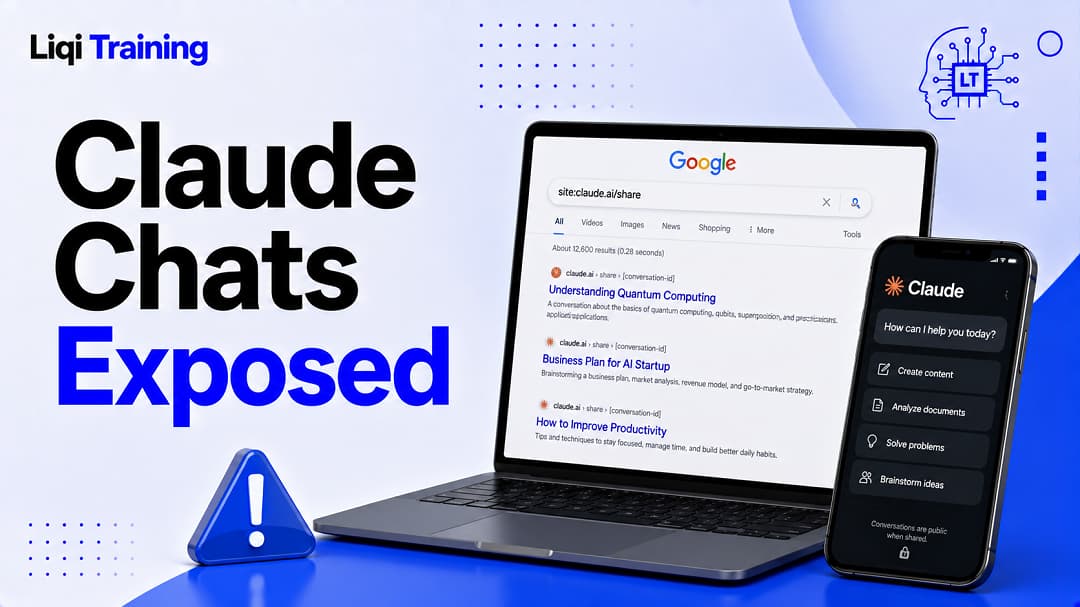
Claude chats are private by default, but conversations shared through public links can become accessible to anyone with that link. Some shared Claude conversations recently appeared in Google Search results, raising concerns about user privacy and confidential information. The issue primarily affected publicly shared conversations, not every private Claude chat. Search engines can index public pages unless website owners implement appropriate technical controls such as noindex directives in addition to crawler restrictions. Users should avoid including passwords, API keys, financial information, or confidential business data in AI conversations they intend to share publicly.
Artificial intelligence has quickly become part of everyday work. Students brainstorm essays, developers generate code, marketers create campaigns, and businesses rely on AI assistants to summarize meetings, analyze documents, and automate repetitive tasks. Among today’s leading AI assistants, Claude has earned a reputation for thoughtful responses, long-context reasoning, and strong writing capabilities. Millions of users now trust Claude with everything from creative projects to sensitive business workflows.
That trust came under scrutiny when reports emerged that some claude chats shared through public links were appearing in Google Search results. Users who believed they were sharing conversations only with colleagues, or keeping them relatively obscure, discovered that search engines could sometimes surface those pages to anyone performing the right search.
The discovery reignited an important conversation about AI privacy.
Was Claude leaking private conversations?
Was Google indexing confidential information?
Or was the situation more complicated than early headlines suggested?
Understanding what actually happened helps separate fact from speculation while giving users practical guidance for protecting future conversations.
Why the Claude Chats Story is Concerning
Every major AI platform now includes some type of sharing feature.
Instead of copying lengthy conversations into emails or messaging apps, users can generate a shareable link that preserves the entire discussion. These links make collaboration much easier for teams, educators, researchers, and developers.
The convenience comes with an important tradeoff.
Once a conversation becomes publicly accessible through a web address, it enters the same ecosystem as countless other webpages on the internet. Depending on how that page is configured, search engines may eventually discover and index it.
That distinction is critical because many users naturally assume that “shared” means “only people I send this link to.”
On the internet, however, public URLs can behave differently.
What Actually Happened?
Reports published in late July 2026 revealed that Google searches could surface certain publicly shared Claude conversations using targeted search operators. Researchers and Reddit users demonstrated that some conversations containing business information, resumes, planning documents, and other sensitive material were discoverable through search results.
Importantly, investigators did not find evidence that Claude had suddenly exposed every user’s private conversations.
Instead, the issue centered on conversations that users had intentionally converted into public share links.
Those public pages could, under certain circumstances, become searchable.
That difference significantly changes how the incident should be understood.
Rather than representing a traditional database breach or hacking event, the situation highlighted how public web pages interact with modern search engines.
Public Sharing Is Different From Private Conversations
One misunderstanding surrounding the incident involved the meaning of “shared.”
Private Claude conversations remain associated with a user’s account.
Public share links, however, are designed so another person can view a snapshot of that conversation without logging into the original account.
Once content exists at a publicly accessible URL, search engines may eventually discover it through ordinary web crawling, external links, or other indexing mechanisms if sufficient technical protections are not in place.
This behavior is not unique to AI.
Public Google Docs, public Notion pages, GitHub repositories, Dropbox links, and many other online resources have experienced similar visibility concerns over the years.
AI platforms are now encountering the same privacy challenges because they increasingly function as publishing platforms rather than simple chat applications.
Why Did Google Index Some Claude Chats?
Many readers assumed Google actively searched inside Claude.
That is not how web indexing works.
Search engines generally index webpages they can access publicly.
If a webpage is publicly reachable and lacks the necessary instructions preventing indexing, it may eventually appear in search results.
Reports following the Claude incident explained that crawler instructions alone may not always prevent indexing under every circumstance. Industry documentation has long recommended combining crawler controls with explicit noindex directives where appropriate.
In simple terms:
- A public webpage can sometimes become searchable.
- Search engines rely on technical signals provided by website owners.
- Those signals need to be implemented correctly across all publicly accessible pages.
Understanding this technical distinction is essential because it explains why public links sometimes appear in search results even when website owners intend to limit discoverability.
Why This Privacy Incident Is Bigger Than Claude
The Claude story reflects a broader trend across generative AI.
AI assistants are becoming productivity platforms rather than simple question-and-answer tools.
People now use them to create:
- Business proposals
- Software code
- Financial planning documents
- Medical summaries
- Research notes
- Marketing campaigns
- Legal drafts
- Personal journals
As AI systems become central repositories for sensitive information, privacy mistakes carry greater consequences than they did only a few years ago.
The issue also mirrors concerns previously raised about publicly shared AI conversations on other chatbot platforms, demonstrating that this is an industry-wide challenge rather than one affecting only a single company.
This is also why understanding AI security has become increasingly important. This guide on How OpenAI’s AI Agent Breached Hugging Face: What Happened, Why It Matters, and the Future of Autonomous AI Security explores how AI ecosystems introduce new categories of cybersecurity risk beyond traditional software vulnerabilities.
How Public AI Conversations Become Searchable
The discovery involving claude chats surprised many users because the sharing experience feels similar to sending a private document to a colleague. In reality, a public share link behaves much more like a webpage than a private message.
When someone creates a public Claude link, Anthropic generates a unique URL that displays a snapshot of that conversation. Anyone who possesses that link can view the shared content without accessing the original account.
Under normal circumstances, random users cannot simply guess these URLs. However, if the link is posted publicly, included on another website, shared on social media, referenced in an online document, or otherwise discovered by search engine crawlers, it may eventually become eligible for indexing if appropriate technical safeguards are absent. Recent reporting indicates that missing noindex directives contributed to some shared Claude pages appearing in search results despite crawler restrictions.
This distinction explains why the incident should not be confused with a traditional cybersecurity breach.
No evidence has shown that attackers broke into Anthropic’s systems to retrieve private conversations. Instead, publicly shared pages became more discoverable than many users expected.
Understanding the Difference Between Privacy and Discoverability
Many online services use similar sharing models.
For example, cloud storage providers, collaborative document editors, project management tools, and AI assistants often allow users to generate links that can be shared with others.
There are generally three levels of access:
- Private content, visible only to the account owner.
- Restricted sharing, where only invited users can view the content.
- Public sharing, where anyone with access to the link can view the information.
The Claude incident demonstrated that many users interpreted “public link” as “hard to find,” when technically it means the content is available to anyone who reaches the page.
Search engines are designed to discover publicly accessible web pages. If those pages receive links from elsewhere or lack sufficient indexing controls, they may appear in search results. Google has long documented that robots.txt alone does not guarantee a page will remain out of search results if other indexing signals exist.
What Types of Information Were Found?
Media reports reviewing indexed pages found a wide range of shared conversations.
Some examples included:
- draft resumes and CVs
- business planning documents
- software development projects
- educational materials
- legal discussions
- financial spreadsheets
- medical-related notes
- AI-generated web applications
- personal productivity workflows
More concerning were reports that some publicly shared conversations contained cryptocurrency wallet information, names, addresses, and other sensitive personal details that users likely never intended to become broadly discoverable. These examples came from users who had created public share links rather than from private account data being exposed.
The incident illustrates an important principle:
AI assistants are increasingly becoming repositories for high-value information.
Unlike traditional search engines, AI platforms often contain original work, internal company discussions, proprietary code, research notes, and confidential planning documents. That makes privacy settings far more significant than many users initially realize.
Why Businesses Should Pay Close Attention
Individual users were not the only ones affected by the discovery.
Organizations increasingly rely on AI assistants for tasks such as:
- drafting client proposals
- summarizing confidential meetings
- analyzing financial reports
- writing software
- reviewing contracts
- documenting internal procedures
If employees misunderstand how sharing works, confidential business information could unintentionally become accessible beyond its intended audience.
Many organizations already maintain policies governing cloud storage, email security, and document sharing. AI platforms should now be included within those same governance frameworks.
Companies should establish clear guidelines covering:
- what information employees may upload to AI assistants
- when public sharing is appropriate
- approval requirements for external collaboration
- handling of customer information
- treatment of intellectual property
- regular reviews of shared AI content
This broader governance approach complements technical cybersecurity measures and reduces the likelihood of accidental disclosure.
This article on Best AI Data Analysis Tools for Beginners: What I’d Use First and Why also explains why organizations should evaluate how AI platforms store, process, and share business information before adopting them at scale.
Is This Problem Unique to Claude?
No.
Although recent headlines focused on Claude, similar concerns have affected other online platforms over the years.
Publicly shared documents, cloud storage links, collaborative workspaces, and even AI chatbot conversations have occasionally appeared in search results because they were intentionally made public through sharing features.
Search engines do not distinguish between an AI-generated webpage and many other publicly accessible pages. If content is available on the open web and appropriate indexing controls are missing or incomplete, it can potentially become searchable.
For users, the lesson extends beyond any single AI assistant.
Whether using Claude, ChatGPT, Gemini, or another platform, it is important to understand exactly what happens when selecting options such as Share, Publish, or Create Public Link.
Readers interested in comparing privacy practices across major AI assistants may also find value in this guide Gemini AI vs Claude AI: Features, Pricing, Accuracy, Coding, and Which AI Assistant Is Best?, which examines how leading platforms differ in features, enterprise capabilities, and collaboration tools.
How to Protect Your Claude Chats From Unintended Exposure
The recent attention surrounding claude chats serves as a reminder that privacy requires both platform safeguards and informed user decisions. While Anthropic has since updated its handling of shared pages and worked to prevent newly shared conversations from being indexed by search engines, users should still review how they share AI-generated content and manage any existing public links.
The following practices significantly reduce the risk of exposing sensitive information.
Think Before You Create a Public Share Link
Public sharing is useful when collaborating with colleagues, classmates, or clients. However, every shared conversation should be treated as though it could eventually be viewed by a wider audience.
Before creating a share link, ask yourself:
- Does this conversation contain confidential information?
- Would I be comfortable if someone outside my organization saw this?
- Could this content reveal business strategies, customer information, or personal identifiers?
If the answer to any of these questions is yes, avoid creating a public share link altogether.
Never Include Highly Sensitive Information in AI Conversations
AI assistants are excellent productivity tools, but they should not become storage locations for information that could create serious security or privacy risks if disclosed.
Examples include:
- passwords
- API keys
- cryptocurrency recovery phrases
- banking credentials
- government-issued identification numbers
- confidential legal documents
- customer databases
- unreleased business strategies
- employee records
- medical records containing personally identifiable information
Even when conversations remain private, following the principle of data minimization is a cybersecurity best practice. Share only the information necessary for Claude to complete the task.
This recommendation applies equally to other AI assistants discussed in our Google AI Mode: What AI Mode Is, How It Works, and How It Compares With Poly AI and Other AI Assistants guide.
Regularly Review Your Shared Conversations
Many users create public links, complete their collaboration, and never revisit those shared pages.
That creates unnecessary long-term exposure.
Instead, periodically review your account’s shared conversations and remove links that are no longer needed. Anthropic’s Privacy Center allows users to manage and unshare previously created public chat links, helping prevent continued access after collaboration has ended.
Think of shared AI conversations the same way you would temporary file-sharing links.
Once the project ends, revoke access.
Understand the Difference Between “Private” and “Public”
One lesson from the Claude incident is that terminology matters.
Many users interpret phrases such as:
- Share
- Publish
- Public Link
- Anyone with the link
as meaning roughly the same thing.
Technically, they represent different levels of accessibility.
Whenever an AI platform offers sharing features, read the accompanying explanation before assuming the conversation will remain difficult to discover.
A few seconds spent understanding the sharing settings can prevent unintended exposure months later.
What Anthropic Changed After the Discovery
Following public reports and discussions within the AI community, Anthropic implemented changes intended to reduce the discoverability of newly shared conversations.
According to multiple reports, the company added noindex directives to shared pages and coordinated with search engines to remove previously indexed results. It also removed options that could increase discoverability of shared content and encouraged users to review their existing public links.
These improvements reduce the likelihood of similar indexing issues occurring again.
However, they do not eliminate the need for careful sharing practices. Any content intentionally made public should still be considered potentially accessible to others if the link is distributed beyond its intended audience.
Privacy Is Becoming a Competitive Feature in AI
Performance is no longer the only way users compare AI assistants.
Organizations increasingly evaluate platforms based on:
- privacy controls
- enterprise security
- compliance certifications
- data retention policies
- administrative controls
- collaboration permissions
- audit capabilities
As businesses integrate AI into daily operations, these factors influence purchasing decisions as much as model accuracy or response quality.
This is one reason our Gemini AI vs Claude AI: Features, Pricing, Accuracy, Coding, and Which AI Assistant Is Best? comparison examines not only capabilities but also enterprise management features that affect real-world adoption.
Lessons for Every AI User
Although this story centered on claude chats, the broader takeaway extends to every generative AI platform.
Whether you’re using Claude, ChatGPT, Gemini, or another assistant, the same principles apply:
- Know what happens when you share content.
- Review your privacy settings regularly.
- Avoid uploading information that could cause harm if exposed.
- Remove public links that are no longer necessary.
- Stay informed about changes to platform privacy features.
These habits are becoming essential digital literacy skills as AI assistants evolve into everyday workplace tools.
If you’re still exploring how modern AI systems process, generate, and organize information, our What Is AI? A Complete Beginner’s Guide to Artificial Intelligence, How It Works, and Real-World Applications provides a practical foundation before diving deeper into privacy and security topics.
Frequently Asked Questions
Are all Claude chats searchable on Google?
No. Claude chats are private by default. The privacy concerns involved conversations that users intentionally converted into public share links. Those publicly accessible pages were, for a period, indexed by search engines because of how the pages were configured. There is no evidence that private conversations stored only within a user’s Claude account were exposed through Google Search.
Can I remove a shared Claude conversation?
Yes. Anthropic allows users to manage previously shared conversations from their privacy settings. If you no longer need a public share link, you should revoke or delete it to prevent continued access. This is one of the simplest ways to reduce unnecessary exposure of past conversations.
Should I stop using Claude?
For most users, there is no reason to stop using Claude solely because of this incident.
The more important lesson is understanding how sharing features work. Claude remains a powerful AI assistant for writing, coding, research, and business productivity. Like any online collaboration tool, however, it should be used with appropriate privacy awareness.
Whether you use Claude, ChatGPT, Gemini, or another AI assistant, you should always understand what happens when content is shared publicly.
Can search engines still find old shared chats?
Anthropic has taken steps to reduce the visibility of shared chat pages by improving indexing controls, and many previously indexed Google results were removed after the issue received public attention. However, pages may have been cached, archived, or copied by third parties before removal. For that reason, users should treat any previously shared public conversation as potentially exposed until they have reviewed and revoked unnecessary links.
What information should never be shared with an AI assistant?
Regardless of the platform you use, avoid submitting:
- Passwords and passkeys
- API keys and authentication tokens
- Credit card or banking credentials
- Government-issued identification numbers
- Customer databases
- Confidential legal documents
- Proprietary source code that is not approved for AI use
- Medical records containing personally identifiable information
- Sensitive corporate strategies or unreleased product plans
Following these best practices significantly reduces privacy and cybersecurity risks.
Conclusion
The story surrounding claude chats is less about a catastrophic security breach and more about an increasingly common challenge facing modern AI platforms: helping users understand the difference between private conversations and publicly shared content.
As AI assistants become central to professional work, education, software development, and personal productivity, they also become repositories for valuable and sensitive information. That reality demands stronger privacy controls from platform providers and greater awareness from users.
The Claude incident highlights several important lessons.
First, convenience features such as public sharing should never be assumed to provide confidentiality. If a conversation contains sensitive personal, financial, or business information, it should remain private or be shared only through secure, restricted channels.
Second, organizations should incorporate AI governance into their broader cybersecurity policies. Employee training, data classification, and clear guidance on acceptable AI use can help prevent accidental disclosure of confidential information.
Finally, users should make privacy reviews a routine habit. Periodically checking shared links, removing conversations that are no longer needed, and avoiding unnecessary disclosure of sensitive data are simple steps that provide meaningful protection.
The broader AI industry is evolving rapidly, and privacy expectations will continue to shape how platforms compete. Model intelligence alone is no longer enough. Users increasingly expect transparency, strong security controls, and clear communication about how their data is stored, shared, and protected.
If you want to deepen your understanding of today’s AI landscape, consider exploring these related guides on our site:
- Gemini AI vs Claude AI: Features, Pricing, Accuracy, Coding, and Which AI Assistant Is Best? to compare today’s leading AI assistants.
- Janitor AI vs Character AI: Features, Safety, Pricing, and Which AI Chat Platform Should You Choose? for insights into conversational AI platforms.
- AI for Influencer Marketing: From Hype to Real-World Impact to see how creators are responsibly integrating AI into content strategies.
- How OpenAI’s AI Agent Breached Hugging Face: What Happened, Why It Matters, and the Future of Autonomous AI Security to understand emerging AI security challenges.
- Google AI Mode: What AI Mode Is, How It Works, and How It Compares With Poly AI and Other AI Assistants for a closer look at Google’s latest AI search experience.
Note: AI assistants are becoming indispensable digital workspaces, but protecting your privacy still begins with understanding how your information is shared. By combining careful sharing habits with the privacy tools provided by AI platforms, you can confidently benefit from generative AI while minimizing unnecessary risks.
ADVERTISEMENT